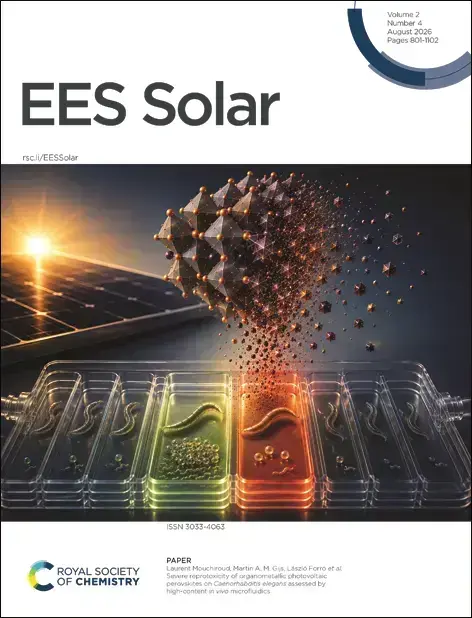
A new study involving Prof. László Forró, director of the Stavropoulos Center for Complex Quantum Matter, reveals important environmental and biological safety considerations for one of the most promising classes of next-generation solar-cell materials. The work, titled Severe reprotoxicity of organometallic photovoltaic perovskites on Caenorhabditis elegans assessed by high-content in vivo microfluidics, is featured on the cover of the August 2026 issue of EES Solar.
Metal-halide perovskites have emerged as exceptional photovoltaic materials because of their high power-conversion efficiencies, relatively simple processing, and potential for integration into tandem solar cells. Yet the presence of lead in widely studied compounds such as methylammonium lead iodide, CH3NH3PbI3, has raised concerns about what could happen if solar modules are damaged, degraded, or improperly disposed of. Replacing lead with another metal is one possible strategy - but the new study demonstrates that “lead-free” does not necessarily mean biologically harmless.
The international research team investigated both the lead-containing perovskite CH3NH3PbI3 and its tin-based analogue CH3NH3SnI3 using Caenorhabditis elegans, a well-established model organism in environmental toxicology. The researchers employed an automated high-content “worm-on-chip” microfluidic platform, following individual organisms over approximately five days while continuously measuring survival, growth, development, egg production, and offspring. Machine-learning-based image analysis automatically identified worms, eggs, and progeny throughout the experiments.
Reproduction emerges as the most sensitive warning signal
The results are striking. Both photovoltaic materials formed particles when introduced into the physiological medium, and their biological effects depended strongly on particle size and bioavailability. Small-particle fractions produced clear, dose-dependent effects on survival, growth, and reproduction. In contrast, larger particles - above approximately 200 nanometers - produced little detectable toxicity under the experimental conditions, consistent with their reduced ability to be ingested by the worms.
Most importantly, reproductive effects appeared at substantially lower concentrations than lethal effects. Even at the lowest concentrations tested, fertility was strongly reduced, while higher sublethal exposures could result in complete sterility. The study therefore identifies reproduction as a particularly sensitive endpoint for assessing the potential ecological consequences of these materials.
The work also provides an important caution concerning lead-free perovskites. Although replacing Pb with Sn can remove the hazards directly associated with lead, the tin-based material still produced substantial biological effects. The results show that changing the metal can reduce some forms of toxicity without eliminating the need for careful toxicological evaluation.
Designing solar materials for performance and safety
The strong dependence on particle size is especially important for real-world applications. Solar modules exposed to mechanical damage, chemical degradation, sunlight, weather, or end-of-life processing can gradually generate smaller particles and soluble degradation products. The study therefore suggests that evaluating only the bulk chemical composition of a photovoltaic material may not be sufficient: the form in which the material becomes biologically available also matters.
The results should not be interpreted as establishing direct toxicity thresholds for humans. Rather, the C. elegans experiments provide a sensitive in vivo platform for identifying potential hazards and quantitative benchmarks that can guide subsequent environmental and mammalian studies. The authors emphasize the need for effective containment of potentially harmful elements during the entire lifetime of photovoltaic devices, together with continued research toward genuinely non-toxic photovoltaic materials.
This perspective is closely aligned with the mission of the Stavropoulos Center for Complex Quantum Matter, which connects fundamental materials research with technological challenges in information technologies, energy harvesting and storage, while explicitly considering environmental impact. The study illustrates how materials science can extend beyond discovering compounds with extraordinary electronic or optical properties to asking an equally important question: How can those materials be deployed safely and sustainably at scale?
The research was carried out through a collaboration involving the Stavropoulos Center for Complex Quantum Matter at the University of Notre Dame, École Polytechnique Fédérale de Lausanne (EPFL), and Nagi Bioscience, among other collaborators. László Forró, Laurent Mouchiroud, and Matteo Cornaglia conceived and designed the project.